Vibe coding resource #6: secure vibe coding policy
You shipped a working app in a weekend using AI. Users signed up, data started flowing, and everything looked great until someone pointed out your API keys were hardcoded, your database had no access controls, and user passwords were stored in plain text. A secure vibe coding policy is the document that stops you from shipping those mistakes in the first place. This resource gives you a ready-to-use policy template, step-by-step setup instructions, and the exact checks that catch security holes before your users find them.


You shipped a working app in a weekend using AI. Users signed up, data started flowing, and everything looked great until someone pointed out your API keys were hardcoded, your database had no access controls, and user passwords were stored in plain text. A secure vibe coding policy is the document that stops you from shipping those mistakes in the first place. This resource gives you a ready-to-use policy template, step-by-step setup instructions, and the exact checks that catch security holes before your users find them.
Photo by Markus Winkler from Pexels
TL;DR:- AI code generators produce insecure code more often than most builders realize. A written security policy catches the gaps before deployment.
- Your policy should cover secrets management, input validation, authentication, dependency scanning, and a pre-deploy review checklist.
- You do not need a security background to implement this. You need a clear document, three free tools, and 30 minutes of setup.
The security gap in AI-generated code
Speed is the whole point of vibe coding. You describe what you want, the AI writes it, you iterate fast. But that speed creates a specific problem: AI models optimize for "code that works," not "code that is secure." The model will happily generate a login system that stores passwords as SHA-1 hashes, build an API endpoint with no rate limiting, or embed your database credentials directly in a config file committed to Git.
"See the figure below, the top foundational models generate at least 36% of insecure code.">, Secure Vibe Coding Guide
That number is not a fringe finding. It means roughly one in three code blocks from leading AI models contains a security vulnerability. When you are building fast and accepting AI output without review, those vulnerabilities stack up. A secure vibe coding policy is a short, written document that defines what security checks happen, when they happen, and what tools enforce them.

Common mistakes that create risk
Most security incidents in vibe-coded projects come from a short list of repeated mistakes. Knowing them makes your policy concrete instead of abstract.
- Hardcoded secrets in source code. API keys, database URLs, and third-party tokens pasted directly into files. Once pushed to a repository, they are exposed forever in Git history.
- No input validation. AI-generated forms and API endpoints often accept any input without sanitization. This opens the door to SQL injection, cross-site scripting (XSS), and command injection.
- Default authentication. The AI sets up a basic auth flow, but skips password hashing upgrades, session expiration, or multi-factor authentication.
- Outdated dependencies. AI models suggest packages based on training data. Those packages may have known vulnerabilities that were patched months ago.
- Missing access controls. Endpoints exist, but there is no check for whether the logged-in user should actually access that data. Any authenticated user can read or modify any record.
gitleaks or trufflehog take under five minutes to set up and will flag exposed credentials immediately.What your policy should cover

A secure vibe coding policy does not need to be long. One to two pages is enough. It needs to be specific. Here are the sections your policy document should include:
Secrets management rules
- All secrets go into environment variables or a secrets manager (e.g.,
.envfiles excluded from version control via.gitignore). - No API key, token, or password appears in any committed file.
- A pre-commit hook running
gitleaksblocks any commit containing a detected secret.
Input validation standards
- Every user-facing input field has server-side validation.
- SQL queries use parameterized statements, never string concatenation.
- HTML output escapes user-provided content to prevent XSS.
Authentication and authorization
- Passwords hashed with
bcryptorargon2(never MD5, never SHA-1). - Sessions expire after a defined period (e.g., 24 hours).
- Every API endpoint checks that the requesting user has permission for the specific resource.
Dependency management
- Run
npm audit,pip audit, or the equivalent for your stack before every deploy. - Pin dependency versions in lock files.
- Review AI-suggested packages before installing. Check the package's last update date and download count.
Pre-deploy review
- A security checklist (provided below) is completed before every production deployment.
- If any checklist item fails, the deploy is blocked until the issue is resolved.
Step-by-step setup
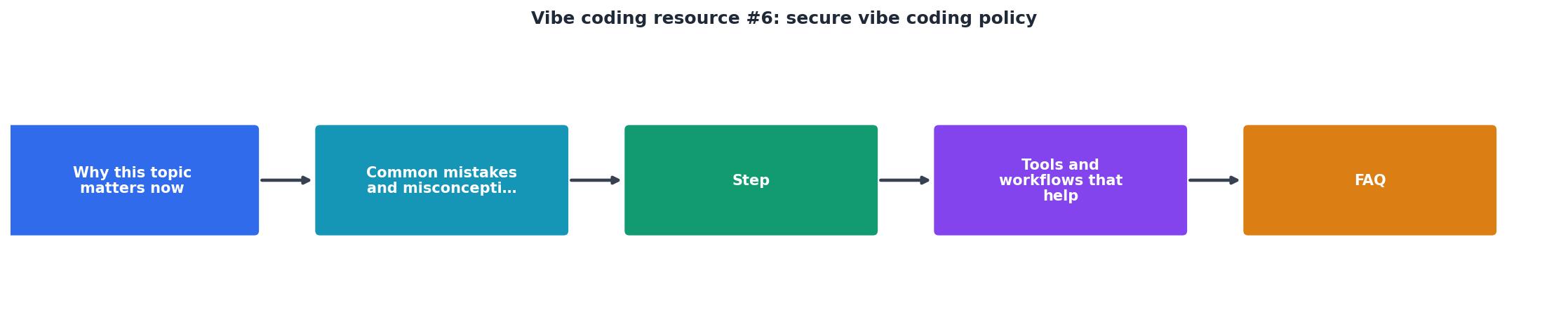
Follow these five steps to go from zero policy to enforced security checks. The labels match the process diagram above.
- Write the policy. Copy the sections above into a
SECURITY_POLICY.mdfile in your project root. Customize thresholds (session length, password requirements) for your app. - Install a secrets scanner. Add
gitleaksas a pre-commit hook. Rungitleaks detecton your existing repo to find anything already exposed. - Add dependency auditing. Add
npm auditorpip auditto your CI pipeline or run it manually before each deploy. - Create the pre-deploy checklist. Use the checklist below. Print it, pin it next to your monitor, or add it as a GitHub issue template.
- Review after every AI session. After each vibe coding session, spend 10 minutes scanning the generated code against your policy. Look specifically for hardcoded values, missing validation, and open endpoints.
Tools that enforce your policy

You do not need expensive enterprise security tools. These free options cover the essentials:
- gitleaks or trufflehog: Scans Git history and staged commits for secrets. Install as a pre-commit hook for automatic enforcement.
- npm audit / pip audit / bundler-audit: Built-in dependency vulnerability scanners for JavaScript, Python, and Ruby projects.
- ESLint security plugins (e.g.,
eslint-plugin-security): Flags common insecure patterns in JavaScript code during development. - OWASP ZAP: Free web application scanner. Point it at your staging URL and it crawls for common vulnerabilities like XSS, injection, and misconfigurations.
- Snyk: Free tier scans your dependencies and container images. Integrates with GitHub for automatic pull request checks.
Secure Vibe Coding Policy Status
Pre-deploy security checklist
Use this checklist before every production deployment. Each item maps directly to a section of your security policy.
Secure Vibe Coding Pre-Deploy Checklist
Your progress is saved automatically in your browser.
FAQ
Frequently Asked Questions
gitleaks as a pre-commit hook takes another 5 minutes. Adding dependency auditing to your workflow takes 5 minutes. The remaining time goes to running your first scan and fixing any existing issues. After setup, the ongoing cost is roughly 10 minutes of review per vibe coding session.gitleaks and run gitleaks detect against your full repository history. If it finds exposed keys or tokens, rotate them immediately (generate new keys, revoke the old ones). Then add the pre-commit hook so no new secrets get committed. After that, run a dependency audit and fix critical vulnerabilities. These two steps address the highest-risk issues in the shortest time.npm audit and eslint-plugin-security, Python projects use pip audit and bandit, Ruby projects use bundler-audit and brakeman. Swap the tool names in your policy document, but keep the same structure and checklist.Additional Resources
- Secure Vibe Coding in 2026: The Files, Prompts and Rules of ... - 1. Write planning files BEFORE LLM writes code · 2. Have RLS from day one and then break it · 3. Rate limit on the backend! · 4. Sensitive API ...
- Secure Vibe Coding Guide | Become a Citizen Developer - Avoid Hardcoding Sensitive Data: Never embed API keys, secrets, database passwords, or other sensitive information directly in your code.
- Secure Vibe Coding - We explore how to secure AI-generated code using tools like Cursor and managing rules. ... When Vibe Coding, Avoid These 6 Security Risks!
Ready to Master Vibe Coding?
Learn to build software faster with AI assistance using the Vibe Coding Bible.
Get Started