How to Drive Innovation Using AI in a Software Project
Software projects live or die on innovation. Not flashy feature-count innovation, but the kind that solves real problems faster, catches bugs before they ship, and lets your team ship what they actually envisioned instead of fighting the codebase. AI changes how that happens. Instead of innovation being something you carve out time for when the sprint ends, AI can be woven into your daily workflow, helping you explore ideas, prototype features, and refactor legacy systems without the usual friction.

Software projects live or die on innovation. Not flashy feature-count innovation, but the kind that solves real problems faster, catches bugs before they ship, and lets your team ship what they actually envisioned instead of fighting the codebase. AI changes how that happens. Instead of innovation being something you carve out time for when the sprint ends, AI can be woven into your daily workflow, helping you explore ideas, prototype features, and refactor legacy systems without the usual friction. The catch is that most teams use AI reactively, asking it for syntax help when stuck. The teams winning are using it strategically, as a creative and analytical partner.

TL;DR
- AI accelerates creative problem-solving by exploring design spaces, generating test cases, and suggesting refactoring approaches you'd never write manually.
- Productivity gains come not from replacing engineering but from eliminating repetitive boilerplate, automating tedious review tasks, and letting developers focus on high-value decisions.
- Novel features, personalization engines, anomaly detection systems, real-time recommendations, ship faster and more robustly when AI handles pattern-finding and initial implementation scaffolding.
- Innovation mindset shifts: experiment iteratively, validate assumptions early, treat AI output as a starting point not a finish line, and build safety nets (tests, staging, monitoring) from day one.
Why Innovation Matters in Software
Innovation isn't optional. Markets shift, competitors adapt, user expectations rise. A codebase that shipped brilliantly two years ago becomes a liability if you can't evolve it. The problem is that most teams don't have bandwidth for innovation. You're delivering features, fixing bugs, keeping the lights on. Innovation gets pushed to "when we have time", which is never.
That statistic isn't a judgment; it's reality. And AI changes the math. When you can generate test suites, scaffold new modules, or brainstorm architectural approaches in minutes instead of hours, innovation stops being a luxury. It becomes embedded in how you work.
Leveraging AI for Creative Problem-Solving

Creative problem-solving with AI means using it to explore possibilities before committing. You're not asking it to build your feature; you're asking it to think through approaches with you.
Architectural brainstorming. When you face a design decision, should this data live in a cache, a queue, or a database?, ask AI to outline the tradeoffs for your specific constraints. Claude or Copilot can map out consistency models, failure modes, and scaling implications in seconds. You validate which resonates with your system, then use that clarity to guide implementation. The human makes the decision; AI surfaces options you'd miss in a solo design session.
Test-driven exploration. Start by asking AI to generate edge-case tests for a module you haven't written yet. This forces you to think through what "correctness" means before writing production code. Many developers skip this because writing test cases feels boring. AI removes that friction. You describe the behavior; it generates scenarios. Then you build the implementation to pass those tests. You've just frontloaded your thinking.
Refactoring patterns. Legacy code has patterns you recognize but haven't quite named. Show a block of AI-assisted code and ask it to identify smell, suggest refactoring, or extract common behavior. It won't always be right, you review it, but it points you toward opportunities you'd skip if the code "just works." Refactoring unlocked is innovation unlocked because you can now build on a foundation that doesn't fight back.
"See how Blue Pearl transformed a legacy codebase, eliminated security risks and accelerated modernization with Bob, cutting delivery time by nearly 90%.">, AI in Software Development
Enhancing Productivity with AI
Productivity gains aren't just about speed. They're about removing friction so developers spend time on judgment calls, not drudgery.
Boilerplate elimination. API scaffolding, CRUD endpoints, configuration files, these are pattern-heavy and repetitive. AI handles them in seconds. You generate the skeleton, review it for security assumptions (credentials handling, input validation), then customize business logic. The time saved isn't huge per endpoint, but across a sprint it compounds. More importantly, you're fresh when you hit the parts that need real thinking.
Documentation and review. AI can draft docstrings, write changelog entries, and generate test coverage reports. A developer can ask: "Summarize what this module does and flag any public methods without docstrings." AI runs that analysis instantly. You review, correct, and ship. Documentation stops being a chore that gets deferred to "end of sprint."
Debugging acceleration. When a bug lands, you describe the symptoms and stack trace to AI. It generates hypotheses, memory leaks, race conditions, state mutations, and suggests where to add logging or breakpoints. It doesn't find the bug for you, but it narrows the search space by half. That's innovation in efficiency.
Developing Novel Features Using AI
Innovation shines brightest when building features that didn't exist before. AI is your partner in getting to market faster and with fewer false starts.
Personalization systems. Netflix's recommendations or Spotify's playlists feel magic, but they're math. If you need to add personalization to your app, whether it's content recommendations, interface adaptation, or workflow optimization, AI helps scaffold the feature. You define the user event stream, AI drafts a collaborative filtering or content-based model, you integrate it into your pipeline. Months of work becomes weeks.
Anomaly detection. Financial fraud, system outages, security breaches, these are patterns in noise. AI models are built for this. You provide training data and thresholds; AI generates a detection system. You integrate alerts into your ops workflow. Where before you had gut feeling and manual review, now you have systematic flagging.
Real-time recommendations. E-commerce, SaaS onboarding, educational platforms, they all benefit from "what should the user see next?" AI generates the logic to score options by relevance, recency, or user profile. You implement it as a service, test it against baselines, and measure impact. The feature ships because AI removed the barrier to initial implementation.
Natural language features. Chatbots, semantic search, intelligent routing, these used to require machine learning expertise. Now? You define the interface, provide example interactions, and AI helps you wire it into your backend. LLM APIs handle the heavy lifting; your job is making sure it integrates cleanly and gracefully falls back when it's unsure.

The Innovation Implementation Process
To turn AI capability into shipped innovation, you need a structured approach.
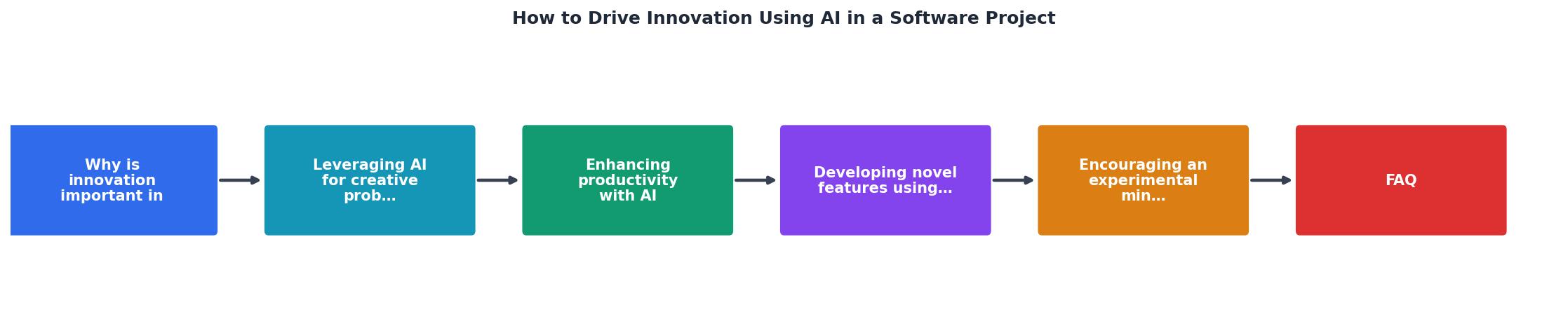
The process is: Ideate, Prototype, Validate, Iterate, and Harden.
Ideate with AI. Sketch the problem. Ask AI to outline approaches, enumerate edge cases, and surface assumptions. Spend thirty minutes here, not three days.
Prototype fast. Use AI to scaffold the core logic. Don't polish; just get something running that demonstrates the idea works.
Validate against real constraints. Does it perform at scale? Does it handle edge cases? Does it integrate without breaking existing systems? Test these assumptions in staging before you commit to hardening.
Iterate on feedback. Bugs? Edge cases? Design misses? AI helps you fix them quickly because you've already built the skeleton.
Harden for production. Add monitoring, error handling, gradual rollout, and rollback logic. This is where human judgment dominates. AI scaffolded the feature; you make it safe and observable.
Encouraging an Experimental Mindset
Innovation dies without psychological safety to experiment. AI enables experimentation by lowering the cost of failure.
Ship experimental branches early. Use feature flags to deploy incomplete or novel features to a subset of users. Gather signal. Does anyone use this? Does it crash? Does it solve the problem? You learn in days instead of guessing for weeks. AI speeds up implementation, so you can afford to run more experiments in parallel.
Celebrate intelligent failures. An experiment that disproves a hypothesis is still successful, it's data. If your team sees failure as punishment, they won't experiment. Create space for "we tried X, learned Y, now we're trying Z." AI makes this easier because the sunk cost is lower.
Pair junior and senior developers on innovative features. Junior developers are less anchored by "that's how we've always done it." Pair them with someone who knows your constraints. Use AI as a thinking partner for both. The junior learns by seeing how the senior validates AI suggestions; the senior learns from the junior's questions about why things work this way.
Run innovation sprints. One week per sprint dedicated to exploration. Not new features on the roadmap, but adjacent ideas, refactoring opportunities, or technical bets. AI lets you test more ideas in parallel because each takes less time to prototype.
Practical Implementation Guide
Ready to drive innovation with AI in your next project? Use this checklist to structure your approach.
AI-Driven Innovation Checklist
Your progress is saved automatically in your browser.
Custom AI Innovation Assessment
To understand how ready your team is to drive innovation with AI, assess your current state:
The gauge above represents a typical team profile. Most engineers are comfortable ideating and iterating, those are core skills. Where teams often stumble is hardening: production monitoring, error handling, rollback logic. AI accelerates the creative loop, but human rigor hardens it for real users. Don't let AI speed trick you into skipping the safety nets.
FAQ
Frequently Asked Questions
What part of your development process feels most constrained by time right now, ideation, prototyping, validation, or hardening? Start there with AI, measure the impact, and iterate. That's how innovation scales.
Additional Resources
- AI in Software Development - AI-powered tools assist developers by suggesting code or generating entire functions from natural language inputs, speeding up development by ...
- AI in Software Development | Microsoft Copilot - Discover how AI software development is transforming the industry. Learn about AI tools designed to help streamline software development and drive innovation.
- How to Use Gen AI in Software Development: 7 Use Cases - AI is transforming software development by making processes faster and more efficient. From automated code creation to enhanced collaboration, the advantages of ...
Ready to Master Vibe Coding?
Learn to build software faster with AI assistance using the Vibe Coding Bible.
Get Started