
You prompted an AI, got a working FastAPI app in twenty minutes, and deployed it the same afternoon. Three days later someone dumped your entire user table because the AI never added authentication to that one admin endpoint. This happens constantly to vibe-coded projects, and the fix is not to stop using AI. The fix is to bolt security guardrails onto your workflow before the code reaches production.
Photo by Took A Snap from Pexels
TL;DR:- AI-generated FastAPI code routinely ships without input validation, proper auth, or rate limiting.
- You can catch most of these gaps with five concrete guardrails: dependency checks, Pydantic validation, OAuth2/JWT auth, CORS lockdown, and automated scanning in CI.
- None of this requires a security degree. It requires a checklist and ten minutes of configuration per project.
Why AI skips security by default
Large language models generate code that satisfies the prompt. If you ask for "a FastAPI endpoint that returns all users," you get exactly that. No authentication middleware. No pagination. No rate limiter. The model did its job. The problem is yours.
This is not a flaw in the AI. It is a flaw in how we use it. Vibe coding moves fast because you skip the boilerplate, but security is boilerplate. It is the boring, repetitive code that protects every route, validates every input, and restricts every caller. When you skip it, you ship an open door.
Three patterns show up in almost every AI-generated FastAPI project:
- No input validation beyond type hints. The AI uses
strorintparameters but never constrains length, format, or range. - Hardcoded secrets. Database URLs, API keys, and JWT secrets appear as string literals in
main.py. - Missing CORS configuration. The default
CORSMiddlewarewithallow_origins=[""]shows up in nearly every generated snippet.
"Now clearly this guy saw AI generating code and thought now he doesn't need any programmers, and AI would build the entire thing on his own and he's going to make money from it.">, Medium
That quote captures the mindset that leads to breaches. The AI builds the thing. You still own the security.
Common mistakes that create vulnerabilities

Here are the specific mistakes I see repeated across vibe-coded FastAPI repos, along with what actually goes wrong.
Trusting Pydantic defaults. Pydantic v2 validates types, but it does not enforce business rules unless you tell it to. An AI-generated User model with email: str accepts "not-an-email" without complaint. You need EmailStr from pydantic[email], plus Field(max_length=255) on every string field.
Skipping dependency injection for auth. FastAPI's Depends() system exists specifically for this. Instead of checking tokens inside each route function, you create a single get_current_user dependency and attach it at the router level. AI-generated code often puts auth checks inline, which means one forgotten route equals one open endpoint.
Using SQLAlchemy raw queries. When the AI builds a search feature, it sometimes concatenates user input into SQL strings. FastAPI + SQLAlchemy's ORM prevents SQL injection by default, but only if you use the ORM. The moment you drop to text() with f-strings, you are back to 2005.
No rate limiting. A single while True loop from an attacker can exhaust your server. The slowapi library wraps FastAPI routes with rate limits in two lines of code. The AI never adds it.
UploadFile has no max size. A 10 GB upload to your free-tier server will crash it.Five guardrails, step by step
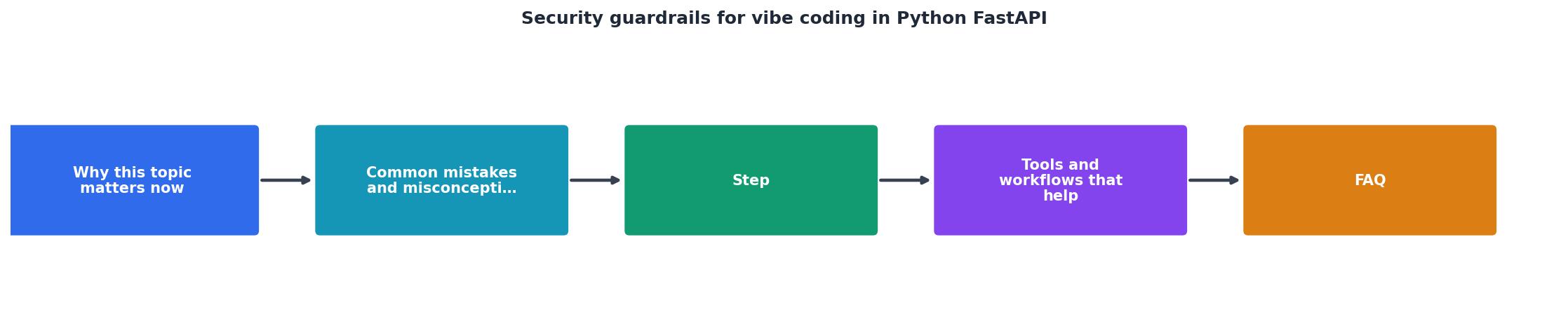
This is the core workflow. Each guardrail addresses one of the gaps above, and they stack. You do not pick one. You add all five.
Guardrail 1: Dependency audit. Run pip-audit against your requirements.txt or pyproject.toml before every deploy. This catches known CVEs in your dependencies. Add it to your CI pipeline so it blocks merges automatically.
Guardrail 2: Strict Pydantic models. Every request body and query parameter gets a Pydantic model with Field() constraints. Minimum lengths, maximum lengths, regex patterns for emails and slugs, and conint(ge=0) for IDs. This is your first line of defense against malformed input.
Guardrail 3: Centralized auth with Depends(). Create a single security.py file with OAuth2PasswordBearer and a get_current_user function that decodes JWT tokens. Apply it at the APIRouter level using dependencies=[Depends(get_current_user)]. Every route on that router is now protected. No exceptions, no forgotten endpoints.
Guardrail 4: Lock down CORS and headers. Replace allow_origins=["
SecurityMiddleware or manually set X-Content-Type-Options, X-Frame-Options, and Strict-Transport-Security headers. FastAPI does not add these by default.
Guardrail 5: Rate limiting with slowapi. Install slowapi, create a Limiter instance, and decorate sensitive endpoints (login, registration, password reset) with @limiter.limit("5/minute"). This stops brute-force attacks and API abuse with minimal code.
| Without Guardrails | With Guardrails |
|---|---|
| Open endpoints, no auth | JWT auth on every router |
allow_origins=[""] | Explicit origin whitelist |
| No input length limits | Pydantic Field() on every model |
| Zero rate limiting | slowapi on sensitive routes |
| Secrets in source code | .env files + pydantic-settings |
Tools and workflows that help

You do not need to memorize OWASP. You need the right tools wired into your workflow.
pip-auditscans your installed packages for known vulnerabilities. Run it in CI withpip-audit --strictto fail the build on any finding.banditis a static analysis tool for Python security issues. It catches hardcoded passwords, use ofeval(), and insecure random number generation. Addbandit -r app/to your pre-commit hooks.pydantic-settingsloads configuration from environment variables and.envfiles. It replaces every hardcoded secret in your codebase with a typed, validated settings class.python-joseorPyJWThandles JWT encoding and decoding. Pair it with FastAPI'sOAuth2PasswordBearerfor a complete auth flow.slowapiwrapslimitsfor FastAPI. Two lines of setup, then decorators on individual routes.
bandit and pip-audit against it, fix what they flag, then deploy. That cycle adds maybe five minutes to your process and catches the majority of AI-generated security gaps.
The Vibe Coding Bible at vibecodingbible.org covers this entire pipeline in depth, including prompt templates that tell the AI to include security from the start.
Here is an example dashboard showing what a typical security scan reveals on a freshly vibe-coded FastAPI project before applying guardrails:
🔍 Pre-Guardrail Security Scan
FastAPI Security Guardrails Checklist
Your progress is saved automatically in your browser.
FAQ
Frequently Asked Questions
pip-audit, bandit, slowapi, and pydantic-settings, creating your security.py auth module, and tightening your Pydantic models. After you have done it once, you can template the setup and apply it to new projects in under 10 minutes.bandit -r app/ on your existing codebase. It gives you an immediate list of security issues ranked by severity. Fix the high-severity findings (hardcoded secrets, use of eval, insecure imports) first. Then move to centralized auth, because unprotected endpoints are the single biggest risk in vibe-coded APIs.bandit and pip-audit catches what the prompt missed. Treat the AI as a fast first draft and the scanners as your reviewer.OAuth2PasswordBearer, OAuth2PasswordRequestForm, dependency injection via Depends(), and automatic request validation through Pydantic. The problem is that AI-generated code often ignores these features or uses them partially. The guardrails in this article ensure you actually use what FastAPI already provides.Additional Resources
- Adding Guard Rails when Vibe Coding - In your repo go to Settings > Code Security > Push Protection. You might need to enable the Code Security first to be able to see those settings ...
- Vibe Coding Exposes Enterprise to AI Security Risks - Security & Guardrails: → LangChain guardrails on input (PII detection, prompt injection, off-topic blocking). → Output guardrails for strict ...
- Vibe Coding Security: Risks and Vulnerabilities - Vibe coding security closes that gap with scanning, guardrails, and governance applied while the code is being generated. AI Guardrails that ...