

Most engineering teams today ship code in at least three languages. A typical product has a TypeScript frontend, a Python or Go backend, and infrastructure written in HCL or YAML. When you layer AI-assisted vibe coding on top of that stack, the productivity gains are real but so are the consistency problems, the tooling fragmentation, and the review headaches that multiply with every additional language. This article breaks down concrete strategies for running multi-language vibe coding across a team without losing control of quality or velocity.
Photo by cottonbro studio from Pexels
TL;DR:- Multi-language vibe coding works when teams standardize prompt conventions, linting rules, and review gates per language.
- Cross-language AI tools like Cursor, GitHub Copilot, and Cody already handle polyglot repos, but they need explicit context boundaries to avoid generating code that drifts between language idioms.
- A shared configuration layer (monorepo config, CI checks, prompt libraries) is the single highest-leverage investment for teams shipping in three or more languages.
What multi-language vibe coding actually means
Vibe coding is the practice of describing intent to an AI and letting it generate working code. Multi-language vibe coding extends that to projects where the AI switches between languages within the same session or repository. A developer might prompt Cursor to write a React component in TypeScript, then switch to a Python FastAPI endpoint, then generate a Terraform module, all inside one monorepo.
The challenge is not that AI models struggle with individual languages. GPT-4o, Claude 3.5 Sonnet, and Gemini 2.5 Pro all handle Python, TypeScript, Go, Rust, and SQL competently in isolation. The challenge is context bleed: the model carries patterns from one language into another. You get Python-style naming in your TypeScript. You get Go error-handling patterns leaking into Rust. You get SQL queries embedded in strings when your ORM has a perfectly good query builder.
For a team of five or more developers, these small inconsistencies compound fast. One person's AI-generated Python uses snake_case for everything. Another's uses camelCase because they prompted the model right after a TypeScript session. Without guardrails, the codebase becomes a patchwork.
Challenges teams face across languages

Three categories of problems show up repeatedly:
- Style drift across languages. Each language has idiomatic conventions. AI models know them but don't always apply them consistently, especially when the conversation context mixes languages.
- Tooling fragmentation. Python uses
rufforblackfor formatting, TypeScript usesprettierandeslint, Go hasgofmt, Rust hasrustfmt. Each language has its own test runner, package manager, and dependency resolution. Coordinating all of these across a team requires deliberate configuration. - Review burden multiplication. A senior Go developer reviewing AI-generated Python may miss idiomatic issues. A frontend specialist reviewing Terraform might approve insecure defaults. Multi-language repos demand either broad expertise or structured review routing.
database/sql call if your linting setup is language-incomplete."Empirical evidence reveals that experienced developers using Cursor with Claude experienced 19% increased completion time rather than anticipated productivity gains [becker2025measuring].">, A Survey of Vibe Coding with Large Language Models
That finding underscores a critical point: AI tools do not automatically make teams faster. Without structure, they can actually slow experienced developers down because the review and correction overhead eats into the generation speed.
Maintain code consistency across languages
The single most effective strategy is a per-language style contract stored in the repository. This is not a wiki page. It is a set of enforced configuration files:
.editorconfigfor universal whitespace and encoding rules- Language-specific linter configs:
ruff.toml,.eslintrc.json,rustfmt.toml - A shared prompt library (a directory of
.mdfiles with system prompts per language)
/prompts
  python-backend.md
  typescript-frontend.md
  terraform-infra.md
  go-services.md
Each file contains the system prompt that developers paste (or auto-load via Cursor rules / .cursorrules) when working in that part of the codebase. The Python prompt specifies snake_case, type hints, pydantic for validation, and pytest for tests. The TypeScript prompt specifies camelCase, Zod schemas, and Vitest. This eliminates context bleed at the source.
Best practices for multi-language environments

Here is what works in practice for teams running three or more languages:
Monorepo with language boundaries. Tools like Nx, Turborepo, or Bazel let you define clear package boundaries. Each package has its own linter, test runner, and build step. AI-generated code lands in a specific package and gets validated by that package's toolchain before it can merge.
CI gates per language. Your CI pipeline should run language-specific checks in parallel. A Python change triggers ruff check, mypy, and pytest. A TypeScript change triggers eslint, tsc --noEmit, and vitest. A Terraform change triggers terraform validate and tfsec. No cross-contamination, no skipped checks.
CODEOWNERS for review routing. GitHub's CODEOWNERS file (or GitLab's equivalent) routes PRs to reviewers who actually know the language. This prevents the "rubber stamp from someone who doesn't read Rust" problem.
Shared interface contracts. When your TypeScript frontend talks to your Python backend, define the contract in a neutral format: OpenAPI specs, Protocol Buffers, or GraphQL schemas. Generate client and server code from the spec. This removes an entire class of cross-language bugs.
The following diagram shows how these pieces fit together in a typical workflow:
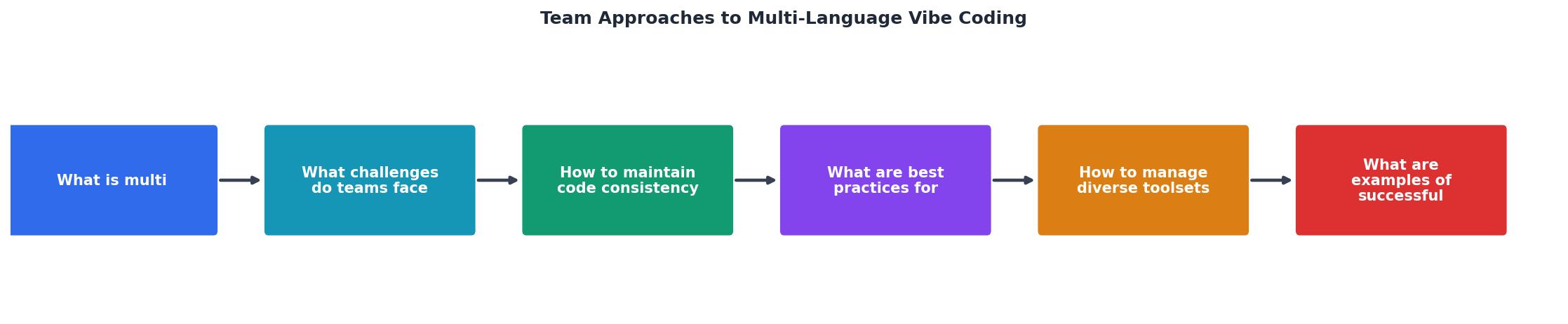
The steps in the diagram: Prompt (developer writes intent using language-specific prompt template), Generate (AI produces code in the target language), Lint (language-specific linter runs automatically), Test (language-specific test suite validates behavior), Review (routed to a reviewer with language expertise), Merge (code lands in the monorepo package).
Managing diverse toolsets

Every language brings its own ecosystem. Python has pip, poetry, and uv. TypeScript has npm, pnpm, and yarn. Go has modules. Rust has cargo. Terraform has providers. Managing all of these across a team requires two things: a standardized local setup and a unified task runner.
For local setup, Dev Containers (VS Code) or Nix flakes give every developer an identical environment regardless of their OS. The container or flake includes every language runtime, every linter, and every tool at pinned versions. No more "works on my machine."
For task running, tools like just, make, or Nx provide a single entry point. just lint runs all linters. just test runs all test suites. just generate-api regenerates API clients from the OpenAPI spec. Developers do not need to remember whether it is pytest or vitest or cargo test for the package they are in.
| Without Unified Tooling | With Unified Tooling |
|---|---|
| Each dev installs tools manually | Dev Container / Nix handles setup |
| Different linter versions across machines | Pinned versions in config |
| Language-specific commands to memorize | Single just or make entry point |
| CI config duplicates local scripts | CI reuses the same task runner |
| Onboarding takes days | Onboarding takes hours |
.tool-versions or mise.toml file that includes AI tool configurations prevents one developer from using a model version that generates incompatible patterns.Real-world multi-language vibe coding teams
Here is a representative example of how a multi-language vibe coding workflow looks in practice for a mid-size product team:
AI-Generated Code Acceptance Rate by Language
The dashboard above illustrates a pattern seen across teams that adopt structured multi-language vibe coding. TypeScript acceptance rates tend to be highest because the language has the most training data and the strictest type system catches errors early. Infrastructure-as-code languages like Terraform or Pulumi tend to have lower acceptance rates because security and compliance requirements add review friction that AI does not automatically satisfy.
A fintech startup running a TypeScript/Python/Go stack reported cutting their sprint velocity gap (the difference between estimated and delivered story points) by 30% after introducing per-language prompt templates and CODEOWNERS-based review routing. The key was not the AI itself but the structure around it.
Optimize workflows for polyglot projects
Speed comes from removing friction, not from generating more code. Here are specific optimizations:
- Auto-detect language context. Cursor's
.cursorrulesand Continue'sconfig.jsonboth support directory-based rule loading. Set them up so that opening a file in/services/auth-go/automatically loads Go conventions. - Batch similar changes. If you need to update an API endpoint, generate the backend handler, the API spec update, and the frontend client call in one session with explicit language switches in your prompts.
- Run cross-language integration tests in CI. Unit tests per language are not enough. Add a small integration test suite (often in Python or TypeScript) that hits the actual API endpoints and validates the contract.
- Track AI acceptance rates per language. The dashboard concept above is not hypothetical. Teams that measure which languages produce the most rejected AI code can focus their prompt library improvements where they matter most.
Multi-Language Vibe Coding Environment Setup
Your progress is saved automatically in your browser.
FAQ
Frequently Asked Questions
.cursorrules directory-based configuration. GitHub Copilot works across languages in VS Code and JetBrains IDEs but lacks per-directory prompt customization without extensions. Continue (open-source) supports custom context providers per language. Sourcegraph Cody indexes entire codebases and provides cross-language context. For CI enforcement, standard tools like ruff, eslint, gofmt, rustfmt, and tfsec remain essential. The Vibe Coding Bible at vibecodingbible.org covers tool selection and configuration in depth for teams evaluating these options.fmt.Errorf," the model complies. If it does not say that, the model takes shortcuts.What is the biggest multi-language challenge your team faces with AI-assisted development? Share your experience so others can learn from it.
Additional Resources
- A Survey of Vibe Coding with Large Language Models - Vibe Coding enables individual developers to deliver team-scale capabilities. Production applications traditionally require coordinating ...
- Taming Vibe Coding: The Engineer's Guide - In this article, I share how my understanding of “vibe coding” evolved and the lessons I've learned. While often seen as a way for non- ...
- A Structured Workflow for "Vibe Coding" Full-Stack Apps - This article is a summary of the key approaches to implementing this workflow. Component libraries and templates are great ways to give the LLM ...