
Non-engineers are no longer locked out of the software development process. AI has fundamentally shifted what it means to contribute to a technical project, making room for designers, product managers, domain experts, and founders to influence code, architecture, and shipping decisions in ways that were once gatekept by computer science credentials. The question is no longer whether non-engineers belong in the room, it's what new roles they'll play and how they'll wield the tools now available.

TL;DR
- AI enables non-engineers to take on roles like AI-assisted developer, quality reviewer, security auditor, and architecture advisor, expanding influence without requiring a CS degree.
- Key skills for non-engineers in AI-driven projects include prompt engineering, critical thinking, domain expertise, and learning to spot red flags in generated code.
- Real examples show founders shipping MVPs, PMs driving technical decisions, and designers architecting systems, all powered by AI collaboration.
- Success means staying skeptical, learning just enough to ask hard questions, and treating AI as a junior developer, not a oracle.
Non-engineers have spent years on the sidelines of technical decisions. A product manager sketches a feature, hands it off to engineers, and hopes for the right interpretation. A designer builds mockups that may or may not translate cleanly to code. A founder with an idea waits for developers to build it, or pays heavily for their time. AI rewrites this script.
Tools like Claude, GitHub Copilot, and Cursor have made it possible for anyone to generate, understand, and critique code. The skill ceiling for entry dropped dramatically. What matters now isn't memorizing syntax, it's knowing what questions to ask, when generated code is wrong, and how to guide AI toward a working solution. Non-engineers who understand this have become force multipliers on their teams.
New Opportunities for Non-Engineers

The roles open to non-engineers in AI-driven development are broader than they've ever been. Here's what's actually happening right now:
AI-Assisted Developer. This is the indie hacker founder or PM who writes code directly using AI, not as a second pair of hands but as a primary tool. They prompt Claude for a React component, review the output, spot bugs, and iterate. They're not learning JavaScript deeply, they're learning how to specify what they want precisely enough that AI understands. This role exists because the feedback loop is fast enough to catch mistakes.
Quality Reviewer. Someone with domain knowledge or user empathy reads generated code and tests it against the requirements. They don't need to understand every line; they need to know if it solves the problem. A product person can do this. A designer familiar with the user journey can do this. They're the sanity check that engineers would normally provide.
Security and Compliance Auditor. Non-engineers with regulatory background or security mindset can spot patterns in generated code that set off alarm bells. Does this query look like it could be SQL-injected? Is this storing passwords in plain text? AI often generates code that "works" but violates best practices. Someone who knows to ask these questions saves the team from catastrophe.
Architecture Advisor. This one surprises people, but a founder or PM who understands the business can guide architectural decisions that an engineer might miss. "We need to handle 10,000 concurrent users eventually" or "this data can never leave EU servers" are non-technical constraints that shape the entire system. AI is good at implementing architecture; non-engineers are good at knowing what architecture the business needs.
Bridging the Technical-to-Non-Technical Gap
The gap between what non-engineers can do and what engineers have traditionally owned is closing because AI handles the translation layer. You don't need to understand how a neural network learns to prompt one effectively. You need to understand your problem well enough to describe it.
Prompt engineering is the first skill. This isn't magical, it's just being specific. Instead of "build me a login system," you say "build a login system that validates email format, hashes passwords with bcrypt, and returns a JWT token. Here's the database schema. Here's the expected response format." Specificity is clarity. AI executes clarity.
Reading code critically comes next. You're not expected to write complex algorithms, but you should be able to read generated code and ask: Does this match what I asked for? Are there obvious bugs? Is this handling the edge case we discussed? A non-engineer with five minutes of experience can spot that a function returns undefined in some paths or that a loop has an off-by-one error. You don't need a CS degree to notice something is wrong; you need a willingness to read carefully.
Translating between business and code is the multiplier. A non-engineer who can say "when the user clicks this button, we need to log an event to Segment so the analytics team can track conversions" is speaking both languages. They can explain it to the engineer (or AI) in terms of code, and explain the AI's output back to the business in terms of outcomes. This skill was always valuable; AI makes it essential because the person asking the question now bears responsibility for asking it correctly.
Learning the boundaries of AI. AI is good at boilerplate, common patterns, and implementations of well-known algorithms. It's bad at novel logic, systems-level thinking, and knowing when to break its own rules for performance. A non-engineer working with AI needs to understand roughly where these boundaries are. That's learned by doing, trying tasks, seeing where AI fails, and building intuition about what to ask a human expert for.
Real-World Examples of Non-Engineers Leading

The shift from theory to practice is already happening across startups and indie projects.
Founders shipping MVPs solo. A designer-founder with no backend experience built a SaaS tool's entire database layer using Claude. They knew what data they needed to track, understood their business model, and prompted AI through the schema design, migrations, and query optimization. They couldn't have written SQL by hand. They didn't need to. They understood the problem space deeply enough to review AI's work. The MVP shipped in weeks instead of months.
Product managers defining architecture. A PM at a growing startup pushed back against the engineering team's plan to build a monolith. They used Cursor to prototype a microservices approach, not to write production code but to understand the tradeoffs. They ran the prototypes, found the latency bottlenecks, and came to the engineering meeting with specific concerns grounded in data. The conversation shifted from "PM doesn't understand" to "here's what we tested and why we need to split services." AI gave them just enough technical literacy to be dangerous in the right way.
Designers architecting features. A design lead at a fintech company described a complex onboarding flow to Claude, including edge cases for different user types. They asked for a component library, state management approach, and data model. The AI output became the starting point for the engineers. The designer's deep understanding of user flows and cognitive load meant the architecture centered on what users actually needed, not what was easiest to code.
These aren't anomalies. They're the new normal. The common thread: the non-engineer had deep domain knowledge, clear requirements, and enough judgment to review AI output. They weren't pretending to be engineers. They were bringing expertise that engineers alone couldn't provide.
Increasing Influence in Technical Teams

Influence doesn't come from credentials. It comes from being reliable, specific, and willing to learn.
Start by being precise about what you need. "I need a way to export user data" is vague. "I need a CSV export that includes these 12 columns, updates when the user clicks a button in the settings page, and only exports their own data" is a specification. Engineers (or AI) can work with specificity.
Ask questions that force clarity. Why are we caching this endpoint? How long does it stay fresh? What happens if the cache is stale? These aren't technical questions dressed up as business questions, they're decision-making questions. Engineers respect people who ask them.
Learn the shape of the system. You don't need to understand every line of code. But knowing that the app has a frontend, an API, a database, and a queue helps you think about where problems live. When something breaks, asking "is this a frontend issue or a backend issue?" is 50% of debugging. Understanding the pieces gives you the vocabulary to be useful.
Get comfortable with AI output quickly. The engineers on your team are still learning this too. If you invest time in understanding how to prompt Cursor or Claude effectively, you'll move faster than teammates who are still typing everything manually. Speed builds credibility.
Protect your team from bad specs and unclear requirements. This is where non-engineers have historically failed and where they can shine with AI. An unclear requirement leads to wasted engineering time and rework. Invest in making requirements crystal clear. Use AI to prototype, test, and validate your ideas before handing them to the team. This is non-engineer work that multiplies engineer productivity.
Here's the process for moving from outsider to influencer in a technical team:
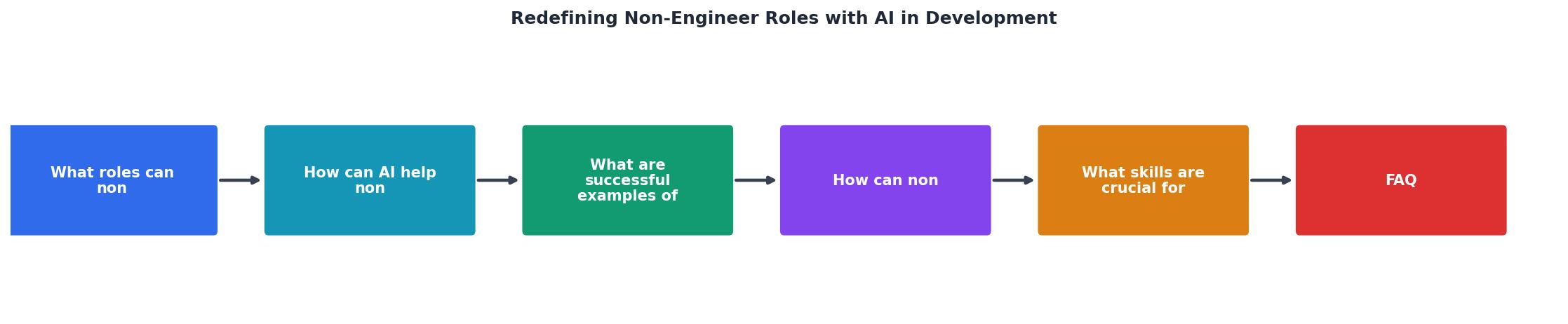
The diagram shows the flow: Start with deep domain knowledge and clear requirements. Use AI to prototype and validate. Ask hard questions about the output. Collaborate with engineers to refine. Ship faster. Build trust. Increase scope and influence. Repeat.
Essential Skills for Non-Engineers in AI-Driven Projects
"The following list covers a few roles with minimal technical barriers to entry.">, AI jobs for non
The skill set for non-engineers in AI-driven development differs from both traditional software engineering and traditional PM roles. It's a hybrid.
Prompt engineering is the foundation. Write clear, specific, detailed prompts. Include examples when possible. Be explicit about constraints and edge cases. Test variations. This is a learnable skill, and you get better with practice.
Critical reading of code and output. You're not writing most of the code, but you're reviewing it. Can you spot when a function might crash? Can you trace through logic and find the bug? This comes from reading carefully, often with the help of AI explaining what the code does.
Domain expertise. Your superpower is understanding the business or user problem better than anyone else. Lean into this. Use it to validate generated solutions. This is where non-engineers outpace pure engineers.
Systems thinking. You don't need to be an architect, but you need to think about how pieces interact. What happens when this service is slow? How does this change affect the user workflow? This holistic thinking catches problems early.
Learning velocity. The tools and best practices are changing fast. Your job is to stay curious and test new approaches. Spend time with AI tools. Break things in safe environments. Build intuition about what they're good and bad at. This is continuous learning, not one-time training.
Judgment under uncertainty. AI output looks confident even when it's wrong. Your job is to know when to trust it and when to seek a second opinion. This is built through experience, using tools, seeing failures, refining your intuition. It's the hardest skill to teach and the most valuable to have.
An Interactive Look at How Non-Engineer Roles Are Evolving
To understand where non-engineer influence is growing most, consider how different roles interact with AI and traditional engineering:
Non-Engineer Influence Growth with AI
This visualization shows that non-engineers no longer influence only on the business side of decisions. They're now directly shaping what gets built and how, working alongside AI to test, validate, and iterate quickly.
Building Your Skill Stack
The path from non-engineer to technical contributor is shorter than it's ever been, but it requires deliberate practice. Start small. Pick a tool like Claude or Cursor. Generate something simple, a small script, a React component, a database query. Read the output carefully. Test it. Break it intentionally. Ask the AI to explain what went wrong. Repeat.
Move to reviewing code written by others. Can you spot the bugs? Can you understand the logic? This skill compounds. After reviewing 50 pieces of code, you develop intuition about what good code looks like and what smells wrong.
Use your domain expertise constantly. That's your advantage. You understand the business, the users, the constraints. Engineers might miss edge cases that are obvious to you. Non-engineers often don't use this advantage enough.
Learn just enough architecture to ask good questions. You don't need to design systems from scratch. You need to understand why a decision matters and what the tradeoffs are. Questions like "why are we using Postgres instead of MongoDB for this?" are valuable conversations. AI can help you research the tradeoffs if you don't know them already.
Stay skeptical. AI is impressive and wrong constantly. Your job is to notice when it's wrong and know what to do about it. Sometimes that's fixing it yourself. Sometimes that's escalating to an engineer. Both are wins.
Making Your Case to Engineering Teams
Engineers sometimes perceive non-engineers using AI as a threat. You're writing code. You're making architectural decisions. You might be wrong, and wrong code is worse than no code. This perception is fair. Your job is to prove you're serious.
Be rigorous about testing. If you're going to claim generated code is ready, test it thoroughly. Edge cases, error states, empty inputs, huge inputs. Prove you're not shipping half-baked solutions just because AI made them fast.
Ask for review, not approval. Bring your work to engineers and say "I built this using AI. I tested it against these cases. I'm not confident about this part, can you review?" This is collaborative. It builds trust. You're not trying to replace engineers; you're amplifying them.
Document your decisions. Explain why you prompted AI a certain way, what alternatives you considered, and what tradeoffs you made. This shows you're thinking, not just copy-pasting.
Admit uncertainty. If you don't know whether generated code is optimal, say so. If you're not sure whether a security practice is sufficient, ask. Engineers respect honest assessment more than false confidence.
Celebrate wins and learn from failures publicly. When your AI-assisted code ships and works well, mention it. When it breaks, own it, investigate, and share what you learned. This builds credibility over time.
Non-Engineer AI Development Readiness Checklist
Your progress is saved automatically in your browser.
FAQ
Frequently Asked Questions
Additional Resources
- AI jobs for non-programmers - You don't need a technical background to get a job in AI. Check out our guide to AI jobs for non-programmers to find the right role for you.
- 8 Non-technical Jobs in AI That Could Be Your Next Career - 8 non-technical jobs in AI to break into the field (without coding) · 1. AI product manager · 2. AI ethicist or Responsible AI advisor · 3. Prompt ...
- AI isn't replacing developers, it's redefining how they work. ... - Now AI helps generate code, find bugs and speed up entire projects. Companies aren't looking for developers who ignore AI. They want ...