

Your team ships code 3x faster with AI assistance. Your security audit flags 47 potential issues with AI-generated dependencies. Your legal team asks: who owns the code? An AI vendor's terms change overnight. You realize nobody documented where training data came from, and now you're exposed to IP claims. Compliance stops becoming a checkbox and becomes your actual job.
TL;DR
- Data governance is the foundation: define what data AI tools see, where it flows, and who can access it. Non-compliance here creates liability fast.
- Intellectual property rights require clear ownership rules in your contracts, training data attribution, and AI vendor terms.
- International standards (GDPR, SOC 2, ISO 27001, sector-specific regs) apply to your AI processes just as they do to manual development.
- Compliance frameworks reduce risk by operationalizing policy: audit trails, code reviews, dependency scanning, and regular assessments.
- AI-powered monitoring tools detect violations proactively, anomalies in data access, unauthorized model usage, or policy drift, before they become incidents.
TL;DR:
Teams adopting AI-assisted development face compliance challenges related to data governance, intellectual property rights, and international standards. Developing compliance frameworks and using AI tools for monitoring are effective strategies. Case studies demonstrate successful navigation of these challenges.
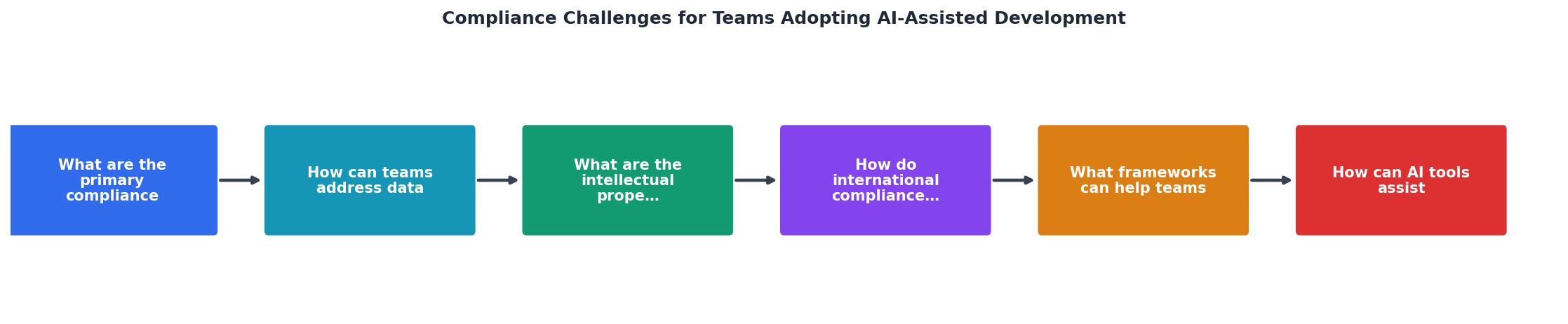
What Are the Primary Compliance Challenges in AI-Assisted Development?

The moment you hand code to an AI and that AI generates something in your production system, you've created new compliance surface area. Unlike traditional software development where a human engineer writes each line, AI-assisted development introduces ambiguity around ownership, training data, and model behavior.
Here are the core challenges:
- Data governance and confidentiality: Your proprietary code, customer data, or trade secrets might flow into an AI model's training set. Did you agree to that? Does your AI vendor retain it?
- Intellectual property disputes: If the model was trained on open-source code, your generated output might inherit GPL or other copyleft licenses. Your company could face claims.
- Regulatory compliance: GDPR, HIPAA, SOC 2, FedRAMP, and sector-specific rules don't pause for AI. If your AI tool processes regulated data without guardrails, you're in violation.
- Audit and accountability: Who approved this code? What model version generated it? Can you trace a security incident back to an AI-assisted line? Traditional code review trails may not exist.
- Third-party vendor risk: Your AI vendor could shut down, change terms, or get sued. Your dependency on their model now becomes your compliance risk.
- License and attribution: Open-source dependencies flagged by AI tools, model weights, and training datasets all carry license obligations.
The stakes are real. Organizations treating compliance as a checkbox face incidents; those operationalizing it see measurable risk reduction.
How Can Teams Address Data Governance in AI Projects?
Data governance in AI development means controlling what data enters the system, who can use it, and where it goes. This isn't new, it's an extension of existing security and privacy practices, but AI amplifies the blast radius.
Start with data classification:
- Identify sensitive data. Customer PII, payment information, health records, proprietary algorithms, and trade secrets must be tagged and protected.
- Define AI access boundaries. Which data can flow to external AI tools? Create an explicit allowlist. Most teams should assume: no customer data, no financial records, no health information goes to public AI models unless contractually allowed.
- Use sandboxed environments. Deploy AI tools (whether cloud-based or on-premises) in isolated networks. If you use Cursor or Claude via API, constrain the context window to code snippets, not full customer datasets.
- Implement data retention policies. Specify how long vendors retain data, whether it's used for model training, and how to request deletion. Codify this in contracts.
- Audit data flows. Log every request to external AI services. Track what data left your network. Use DLP (Data Loss Prevention) tools to alert on suspicious outflows.

What Are the Intellectual Property Considerations in AI Development?
IP risk in AI development flows in multiple directions: what the AI was trained on, what it generates, and what you incorporate into your product.
Training data attribution:
If your AI tool (Copilot, Claude, etc.) was trained on public datasets, GitHub repositories, or open-source projects, your generated code may include patterns from those sources. Some licenses (GPL, AGPL) require you to disclose and release derivatives under the same license. Others (MIT, Apache 2.0) are permissive. The problem: you may not know what your model was trained on.
Generated code ownership:
Most AI vendor terms (OpenAI, Anthropic, GitHub Copilot) grant you ownership of generated code, but read the fine print. Some require you to acknowledge AI assistance. Others reserve rights if the output matches existing open-source code verbatim.
Dependency scanning and license compliance:
AI models often suggest dependencies. A tool like Snyk or Black Duck scans your code and flags licenses. If an AI suggestion pulls in a GPL dependency and you didn't intend copyleft, you're now legally bound to release your source. Vet AI suggestions through your existing license audit process.
Practical steps:
- Maintain a record of which AI tools generated which code sections. Use code comments or git metadata.
- Run all AI-generated code through license compliance tools before merge.
- Include AI assistance in your open-source contributor agreements and license headers.
- Negotiate vendor terms upfront: Do they claim ownership? Can they use your code for training? What's your indemnification if their model was trained on problematic data?
How Do International Compliance Standards Affect AI Projects?
Compliance frameworks don't have an "AI exception." GDPR, HIPAA, SOC 2, FedRAMP, and other standards apply to any system processing regulated data, including AI-assisted development environments.
GDPR and data processing:
If your AI tool processes data of EU residents, you're subject to GDPR. This means:
- Your AI vendor must be a compliant Data Processor (contractually confirmed via a DPA).
- Users have a right to know AI systems are processing their data.
- You must document the purpose, lawful basis, and retention period.
- Data minimization: only send AI tools the minimum data needed.
If you build healthcare software, your development environment cannot process real patient data through public AI models. Use on-premises, isolated AI systems for this context. Vendors must sign Business Associate Agreements (BAAs).
SOC 2 and vendor audit trails:
SOC 2 Type II auditors will ask: How do you ensure AI-generated code meets your control requirements? You'll need to document code review processes, testing, and approval workflows. If an AI tool is part of your CI/CD pipeline, it must be part of your control environment.
FedRAMP (government contracting):
If you sell to the US federal government, every tool, including AI, must be authorized. Most commercial AI services are not FedRAMP-approved. You'll need a separate, authorized development environment.
Sector-specific rules:
Financial services (SOX, PCI DSS), insurance, automotive, and aviation all have compliance regimes. AI doesn't exempt you; it adds complexity.
Your checklist:
- Map your regulated data types to applicable standards.
- For each standard, identify where AI systems interact with that data.
- Require AI vendors to be contractually compliant (DPA, BAA, SOC 2 report, etc.).
- Document that you've assessed AI tools against your compliance requirements.
- In your audit, demonstrate that AI-assisted code paths meet the same controls as manual development.
What Frameworks Can Help Teams Maintain Compliance?
A compliance framework operationalizes policy. It turns "we should be compliant" into repeatable, auditable processes.
Core components of an AI compliance framework:
- Policy and governance: Written rules on which AI tools are approved, what data they can access, and who can use them. A central team (security, legal, compliance) reviews and updates this quarterly.
- Vendor assessment: Before adopting an AI tool, audit its privacy terms, security certifications, and compliance obligations. Create a reusable assessment template.
- Code review workflow: AI-generated code must go through the same review process as human-written code, but with added scrutiny. Reviewers check for license compliance, data leakage, and unusual patterns.
- Dependency scanning: Integrate tools like Snyk, Black Duck, or FOSSA into your pipeline. Flag AI-suggested dependencies that introduce compliance risk.
- Audit trail and logging: Record which AI tool generated which code, when, by whom, and what it touched. Use git commits, metadata, or a centralized log. Make this queryable for audits.
- Testing and validation: AI-generated code must pass the same test suite as manual code. No shortcuts on test coverage.
- Incident response: If AI-generated code causes a breach, can you trace it? Do you have a playbook for notifying stakeholders?
- Regular assessment: Quarterly or annual review of AI tools, vendor compliance, and policy effectiveness. Adapt as regulations change.

Here's a concrete example: A fintech company built a compliance framework by creating a policy document (1 page, reviewed by legal), a vendor assessment checklist (10 questions), and a code review checklist (3 compliance-specific items: license flagged? customer data in context? model version documented?). They integrated Snyk into CI/CD, logged all AI requests to a central bucket, and trained their team in 30 minutes. Cost: one month of engineering time. Benefit: they passed audit with zero findings on AI governance.
How Can AI Tools Assist in Monitoring Compliance?
This is the irony: you can use AI to enforce compliance on AI-generated code.
Automated monitoring techniques:
- Static analysis with compliance rules: Tools like SonarQube can be configured with custom rules (e.g., "flag any code in the payments module generated after this date"). Extend your linter to check for AI assistant metadata.
- Dependency scanning: Snyk, Black Duck, and Dependabot scan every dependency, flag licenses, and alert on vulnerabilities. Integrate into your pipeline as a gate.
- Data access monitoring: If an AI tool makes an API call to fetch production data (it shouldn't), DLP tools and cloud access logs will catch it.
- Model version tracking: Log which AI model generated code. If a vendor releases a problematic update, you can identify affected code and re-review it.
- Anomaly detection: ML-based tools can flag unusual patterns in code, very large functions, unusual library imports, or access patterns that don't match your team's baseline. Not all anomalies are compliance issues, but they're signals.
- Audit trail querying: Centralize logs from your AI tools, code review platform, and CI/CD. Build dashboards to answer: "How many lines were AI-generated this month?" "Which developers used Claude?" "Did any code touch PII?"
"Gartner predicts that by 2026, organizations that operationalize AI governance will experience 40% fewer AI-related compliance incidents than those relying on policy alone.">, How to ensure compliance when adopting AI technologies
Tool recommendations:
- For license scanning: Black Duck, Snyk, or FOSSA.
- For code quality and compliance: SonarQube, Checkmarx, or Fortify.
- For data access control: Okta, CyberArk, or HashiCorp Vault.
- For audit logging: CloudTrail (AWS), Stackdriver (GCP), or Azure Monitor.
- For dependency management: Dependabot, WhiteSource, or JFrog Artifactory.
What Are Some Examples of Teams Overcoming Compliance Challenges?
Real teams have navigated this. Here's what worked:
Case 1: A SaaS company in regulated finance
Challenge: They wanted developers to use Copilot to move faster, but their compliance team said "no way", Copilot was a black box, trained on arbitrary code, and violated their vendor policies.
Solution: They negotiated with GitHub (Copilot's vendor) to review compliance documentation, got a Data Processing Agreement, and then implemented a controlled rollout. Developers could use Copilot on non-financial modules only. Financial code remained manual or used an on-premises model. Code review got tighter: two reviewers for Copilot code. They passed their next audit by documenting this process and showing zero Copilot-generated financial code.
Lesson: Vendor negotiation and targeted rollout beats blanket bans.
Case 2: A health tech startup
Challenge: They built AI-assisted code generation for clinical decision support. HIPAA requires audit trails and data minimization. Their developers were casually pasting snippets of patient data into Claude to debug.
Solution: They built a custom wrapper around their AI tool that strips PII before sending prompts. Developers type normally; the wrapper detects patterns (phone numbers, SSNs, medical record IDs) and redacts them before the API call. They log every redaction. Their HIPAA audit went smoothly because they could show: zero PII left the network, and all actions were logged.
Lesson: Technical controls (PII redaction) are more reliable than policy alone.
Case 3: An open-source maintainer
Challenge: Contributors started using Copilot, and the maintainer worried about GPL violations. Could a Copilot suggestion inherit GPL from training data? They didn't know.
Solution: They added a contributor guide: disclose AI assistance, pass AI-generated code through license scanning (fossid), and if the tool suggests GPL-licensed code, document it explicitly. No rejections, just transparency and traceability. The community appreciated the honesty.
Lesson: Transparency and automation beat prohibition.
Your Team's AI Compliance Status
The above dashboard shows what a mature compliance posture looks like: active policies, vendor checks, consistently enforced code review gates, zero license violations in 1,247 scans, and regular assessment cycles. This isn't theoretical, it's what teams running production AI-assisted development actually achieve.
Practical Artifact: AI Development Compliance Framework
Use this checklist to operationalize compliance in your own team:
AI Development Compliance Checklist
Your progress is saved automatically in your browser.
FAQ
Frequently Asked Questions
Additional Resources
- AI Code Security Risks: Governance and Compliance in ... - AI-generated code may fail to include proper checks for user input, increasing the risk of injection attacks or data corruption.
- How to ensure compliance when adopting AI technologies - AI compliance in software engineering starts with treating AI tools the same way you treat any other system that touches sensitive data: ...
- Governance Challenges In AI-Assisted Software ... - Inconsistent AI usage across teams can create fragmented workflows, uneven code quality, duplicated efforts, and governance gaps. Enterprises ...